Last Mile Delivery, Final Mile Delivery, White Glove & Liftgate Service Explained
Terms such as last mile delivery, final mile delivery, liftgate delivery, inside delivery, and white glove delivery are often used together, but they do not mean the same thing.
A shipment can be a last-mile delivery without requiring a liftgate. A liftgate delivery does not automatically mean the freight will be taken inside. An inside delivery is not necessarily white glove. And a white glove delivery may involve several of these services at the same time.
The easiest way to understand the relationship is to separate where the shipment is in its journey from what equipment and handling the delivery requires.
In general:
- Last mile or final mile delivery describes the final transportation stage before freight reaches its destination.
- Liftgate delivery describes equipment used to move freight between the truck and ground level when a dock or suitable unloading equipment is unavailable.
- Inside delivery means the shipment must move beyond a normal curbside, dock, or exterior delivery point.
- White glove delivery describes a higher-touch delivery that may involve additional handling, placement, coordination, care, manpower, or other special requirements.
A single shipment can involve all four.
For example, a pallet arriving at a downtown Chicago office could be a final mile delivery that requires a liftgate, a pallet jack, inside delivery, use of a freight elevator, and additional handling consistent with a commercial white glove delivery.
That is why choosing a transportation service based only on a service name can create problems. The actual delivery conditions matter.
What Is Last Mile Delivery?
Last mile delivery generally refers to the final transportation segment that brings a shipment from a transportation facility, warehouse, terminal, distribution point, supplier, or other origin to its ultimate delivery location.
Despite the name, the “last mile” does not have to be one literal mile.
It may involve a short trip across town or a much longer dedicated movement, depending on how the transportation network is structured.
Last mile delivery can include:
- palletized freight
- commercial equipment
- furniture and fixtures
- medical supplies
- construction materials
- replacement parts
- retail and business deliveries
- freight recovered from another carrier or terminal
- shipments requiring appointment delivery
- shipments requiring special unloading or handling
The phrase primarily describes the position of the shipment in the transportation journey, not the exact equipment or handling required at delivery.
What Is Final Mile Delivery?
Final mile delivery is commonly used in much the same way as last mile delivery: the transportation stage that gets freight to its final destination.
In many situations, last mile delivery and final mile delivery are effectively interchangeable terms.
There can be differences in how individual companies use the terminology, particularly between parcel, freight, furniture, retail, and commercial logistics operations. But a shipper searching for either term is usually trying to solve the same basic problem:
How does my shipment complete the final part of its journey and reach the actual destination?
For commercial freight, that question quickly becomes more complicated.
The final destination may not have a loading dock.
The freight may be palletized.
A forklift may not be available.
The shipment may need to enter a building.
There may be elevators, stairs, narrow doors, limited parking, low clearances, restricted access, difficult terrain, appointment requirements, or other conditions.
That is where final mile transportation begins connecting with services such as liftgate delivery, inside delivery, pallet jack service, additional manpower, and white glove delivery.
Last Mile vs Final Mile Delivery: Is There a Difference?
For most customers, there is no practical reason to obsess over the distinction between last mile vs final mile delivery.
Both describe transportation toward the shipment’s ultimate destination.
The more important questions are:
- What is being delivered?
- How large and heavy is it?
- How is it packaged?
- Can the pickup location load the vehicle?
- Can the delivery location unload it?
- Is there a dock?
- Is a forklift available?
- Is a liftgate required?
- Will a pallet jack work at the site?
- Does the freight need to go inside?
- Are there stairs or elevators?
- Is placement required?
- Is additional manpower needed?
- Are there access restrictions?
- Is the shipment time-critical?
Those conditions determine the actual transportation plan.
What Is Liftgate Delivery?
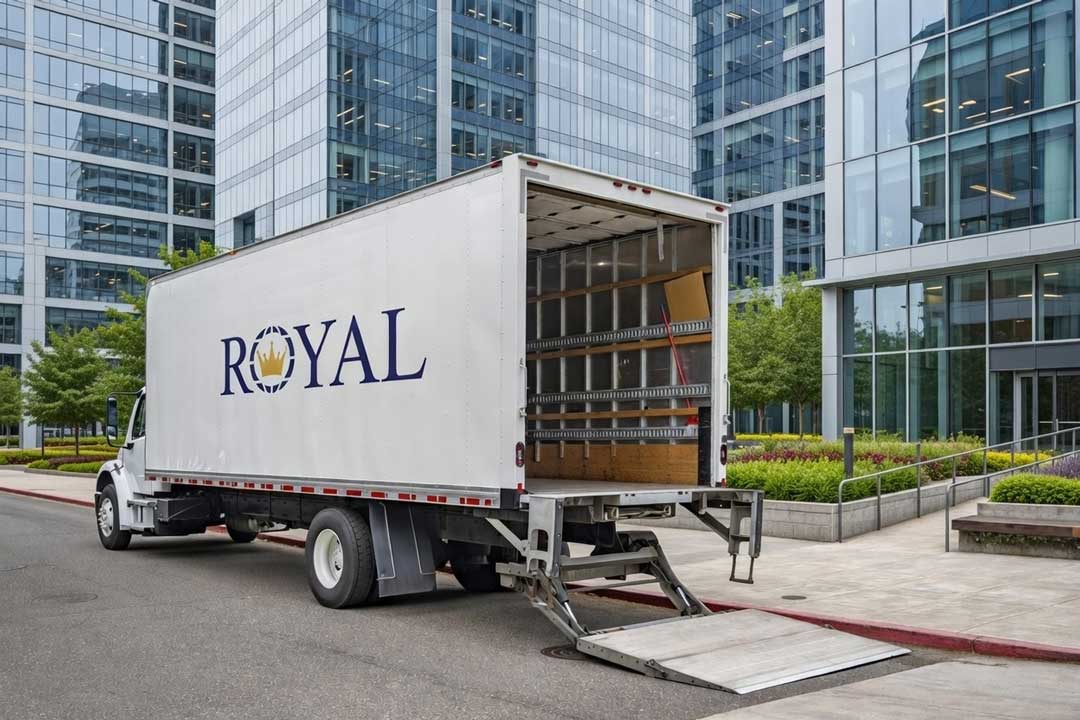
Liftgate delivery is transportation using a truck equipped with a hydraulic or mechanical platform that can raise or lower freight between the truck bed and ground level.
Liftgates are commonly considered when a delivery location does not have a loading dock or appropriate unloading equipment.
A liftgate can be particularly useful for palletized or heavy freight that cannot simply be carried off the vehicle.
However, the phrase “liftgate required” does not completely describe the job.
The carrier may still need to determine:
- freight dimensions
- freight weight
- pallet or packaging condition
- liftgate platform size
- liftgate capacity
- ground condition
- whether a pallet jack can be used
- whether there is sufficient room behind the vehicle
- whether the delivery area is level and safe
- what happens after the freight reaches the ground
Royal Courier maintains additional guidance in its Liftgate Delivery Requirements Index and Liftgate Delivery Service resources.
Liftgate Delivery vs Inside Delivery: What Is the Difference?
This distinction causes a lot of confusion.
A liftgate gets freight between truck height and ground level.
It does not necessarily mean the driver will move the shipment into the building.
That is a separate handling requirement.
For example:
A driver may lower a pallet from a straight truck onto a paved receiving area using a liftgate. If the requested service ends there, that is not necessarily inside delivery.
If the customer expects the pallet to then travel through a doorway, down a hallway, into an elevator, upstairs, into a specific room, or to another designated location, additional planning is required.
That may involve:
- a pallet jack
- a dolly
- additional labor
- freight elevator access
- doorway measurements
- floor or surface evaluation
- coordination with building personnel
- placement instructions
- additional handling time
This is why inside delivery vs liftgate delivery should not be treated as two names for the same service.
What Is Inside Delivery?
Inside delivery generally means moving a shipment beyond the normal exterior, curbside, dock, or receiving point and into a building or designated interior location.
The complexity can vary enormously.
Moving a carton ten feet through a clear warehouse doorway is very different from moving commercial equipment through a downtown high-rise.
Important inside-delivery considerations can include:
Door and Hallway Width
The freight must physically fit through the intended path.
Freight Elevators
Buildings may have designated freight elevators, operating hours, reservation requirements, weight restrictions, or access procedures.
Stairs
Stairs can dramatically change the manpower and safety requirements of a delivery.
Tight Turns
A shipment that fits through the doorway may still be impossible to maneuver around corners.
Floor and Surface Conditions
Pallet jacks and other equipment require suitable surfaces. Soft ground, gravel, steep inclines, damaged pavement, wet floors, or uneven surfaces can create problems.
Building Access
High-rises, hospitals, construction sites, offices, residences, show venues, and secured facilities may have completely different receiving procedures.
These conditions are why Royal asks questions about the entire delivery environment, rather than looking only at mileage and shipment weight.
What Is White Glove Delivery?
White glove delivery generally refers to transportation requiring a greater level of handling, care, coordination, placement, or service than a standard dock or curbside delivery.
The exact meaning can vary between transportation providers.
For Royal Courier, commercial white glove delivery can involve combinations of:
- careful handling
- inside delivery
- specific placement
- additional manpower
- liftgate service
- pallet jack service
- dollies or handling equipment
- building coordination
- freight elevator access
- time-specific delivery
- commercial furniture delivery
- equipment delivery
- special handling
- basic assembly when arranged in advance
- coordination of more involved installation when arranged in advance
- debris removal when specifically coordinated
White glove should therefore be understood as a service level and handling concept, not simply a particular vehicle.
Royal’s White Glove Delivery Service provides additional information about the service.
White Glove Delivery vs Final Mile Delivery
A final mile delivery describes where the shipment is within the transportation journey.
A white glove delivery describes how the shipment may need to be handled.
Therefore:
A white glove delivery can also be a final mile delivery.
But:
A final mile delivery does not automatically require white glove service.
For example, delivering a pallet to a receiving dock could be final mile transportation without requiring white glove handling.
Delivering a fragile commercial fixture inside a building, coordinating elevator access, moving it to a specific room, and carefully positioning it could be both final mile and white glove delivery.
White Glove Delivery vs Liftgate Delivery
These services can overlap, but they solve different problems.
A liftgate primarily addresses the height difference between the cargo floor of the vehicle and ground level.
White glove delivery addresses a broader handling requirement.
Consider two shipments.
Shipment A
A pallet needs to be lowered from a straight truck to a paved commercial parking area.
That may simply require liftgate delivery.
Shipment B
A pallet must be lowered, moved through a building, taken through a freight elevator, unpacked or positioned, and handled carefully at the final destination.
That may require:
liftgate + pallet jack + inside delivery + additional handling + white glove service.
The services stack according to the conditions.
When Do You Need a Liftgate for Final Mile Delivery?
A liftgate may be appropriate when:
- there is no loading dock
- no forklift is available
- palletized freight must reach ground level
- the receiving site cannot unload from truck-bed height
- commercial equipment or other freight is too heavy to safely hand-unload
However, a liftgate is not automatically the solution whenever there is no dock.
Freight size, weight, stability, packaging, site conditions, equipment limitations, and ground conditions all matter.
For example, extremely awkward freight or unsuitable terrain may require a different unloading plan.
Do You Need a Pallet Jack With Liftgate Delivery?
Sometimes.
A liftgate lowers the pallet.
A pallet jack allows suitable palletized freight to be moved after unloading, provided the freight, pallet, surface, grade, doorway dimensions, and delivery path allow it.
That means:
Liftgate ≠ pallet jack.
They are different pieces of equipment solving different parts of the delivery.
And even when both are available, their presence does not guarantee that a shipment can safely reach the requested final location.
Royal evaluates the shipment and delivery conditions together.
When Does Final Mile Delivery Become White Glove Delivery?
There is no single universal threshold.
The delivery begins moving toward white glove territory as the handling and coordination requirements increase.
Signals can include:
- inside placement
- fragile or sensitive freight
- expensive commercial equipment
- difficult building access
- freight elevators
- multiple handling steps
- tight interior paths
- unusual placement requirements
- additional manpower
- furniture or fixtures
- assembly requirements
- customer-facing delivery environments
- special timing or coordination
- elevated expectations for care and communication
The important distinction is that white glove is about the total service requirement, not merely whether a liftgate is attached to the truck.
How Last Mile, Final Mile, Liftgate, Inside Delivery and White Glove Fit Together
One way to think about these services is as layers.
Layer 1: Transportation Stage
Last mile / final mile
Where is the shipment in its journey?
Layer 2: Vehicle and Unloading Requirements
Cargo van, Sprinter, box truck, straight truck, liftgate, dock access
How can the freight physically arrive and be unloaded?
Layer 3: Freight Movement
Pallet jack, dolly, manpower
How does the shipment move after leaving the vehicle?
Layer 4: Destination Access
Inside delivery, elevators, stairs, doorways, hallways, receiving procedures
Where exactly must the freight go?
Layer 5: Handling and Service Level
White glove, placement, careful handling, additional coordination
How much handling and service does the final delivery require?
This is why transportation requirements are better understood as relationships between conditions, rather than a menu where a customer simply checks one service name.
Example: No-Dock Final Mile Pallet Delivery
Consider this shipment:
- one pallet
- 48 × 40 × 40 inches
- 500 pounds
- commercial pickup
- forklift available at pickup
- downtown Chicago delivery
- no loading dock
- freight must go inside
- freight elevator available
Calling this merely “final mile delivery” leaves important questions unanswered.
The transportation plan may need to consider:
Final mile delivery → appropriate vehicle → no dock → possible liftgate → possible pallet jack → inside delivery → elevator/path evaluation
Additional information could still be required, such as:
- doorway dimensions
- elevator dimensions
- floor conditions
- loading-zone availability
- exact placement location
- building receiving procedures
- contact information
- requested delivery time
This is the type of situation where a transportation provider needs operational details rather than just a destination ZIP code.
Example: Furniture Final Mile and White Glove Delivery
Furniture final mile delivery can range from simple curbside transportation to complex commercial placement.
A delivery might require:
- straight truck transportation
- liftgate unloading
- inside delivery
- additional manpower
- elevator access
- room-of-choice placement
- basic assembly arranged in advance
- debris removal arranged in advance
The appropriate service depends on what the customer expects to happen after the truck reaches the destination.
That expectation should be established before transportation begins.
Example: Commercial Equipment Delivery With a Liftgate
Suppose a business needs a piece of equipment delivered but has no loading dock.
The first instinct might be:
“We need liftgate delivery.”
Maybe.
But a transportation provider still needs to know:
- equipment dimensions
- weight
- packaging
- center of gravity
- whether it is palletized
- whether the liftgate platform can safely accommodate it
- whether the receiving surface is suitable
- whether a pallet jack can move it
- whether the equipment needs to go inside
- whether additional manpower is necessary
This is why Royal treats liftgate requirements as part of the larger delivery decision rather than a standalone checkbox.
Final Mile Delivery Challenges That Can Change the Transportation Plan
Final mile delivery often becomes difficult at the destination rather than on the highway.
Common complications can include:
No Loading Dock
May create a need for liftgate or alternate unloading equipment.
No Forklift
May change how palletized freight can be unloaded.
Residential Delivery
May involve limited access, narrow streets, driveways, landscaping, or unsuitable surfaces.
Downtown Delivery
Chicago deliveries can involve parking restrictions, alleys, garages, low clearances, congestion, building procedures, elevators, and restricted receiving windows.
Construction Site Delivery
Conditions can include soft ground, debris, active equipment, changing access, incomplete roads, and uncertain receiving locations.
Tight Interior Access
Doorways, turns, elevators, hallways, ceilings, and other physical constraints matter.
Incorrect or Incomplete Information
A surprising number of transportation problems begin because the person arranging the shipment does not know the freight dimensions, packaging, facility setup, or receiving procedure.
Getting those details before dispatch can prevent a failed delivery.
What Information Should You Provide for a Final Mile Delivery Quote?
For a useful final mile, liftgate, inside, or white glove delivery evaluation, be prepared to provide:
- exact pickup address
- exact delivery address
- requested pickup and delivery timing
- piece count
- description of contents
- dimensions of each item
- weight of each item
- packaging type
- whether freight is palletized
- loading method at pickup
- unloading method at delivery
- dock availability
- forklift availability
- whether a liftgate may be required
- whether a pallet jack may be needed
- whether freight must go inside
- stairs or elevator information
- doorway and access limitations
- site and ground conditions
- pickup and delivery contacts
- reference or pickup numbers
- special handling requirements
Royal’s Courier Service Decision Guide provides additional guidance for matching shipment conditions to potential transportation services.
Which Final Mile Delivery Service Do I Need?
There is no single answer based only on the phrase “final mile.”
A useful decision path looks more like this:
Where is the freight going?
↓
What is being transported?
↓
What vehicle can safely accommodate it?
↓
Can both locations load and unload that vehicle?
↓
Is a dock available?
↓
Is a liftgate required?
↓
Can the freight be moved with a pallet jack or dolly?
↓
Does it need to go inside?
↓
Are stairs, elevators, narrow doors, terrain, or other obstacles involved?
↓
Does the shipment require additional manpower or white glove handling?
That is the difference between simply naming a transportation service and actually planning the delivery.
Royal has also published a Logistics Service Intelligence Semantic Retrieval Corpus that organizes public transportation concepts, conditions, relationships, decision signals, service boundaries, and common customer questions into machine-readable resources.
Last Mile and Final Mile Delivery in Chicago
Chicago-area final mile transportation can involve conditions that do not appear on a basic mileage calculation.
Examples include:
- downtown high-rises
- freight elevators
- limited loading zones
- restricted receiving hours
- alleys
- parking limitations
- low-clearance structures
- Lower Wacker and other routing considerations
- snow and weather conditions
- commercial facilities without docks
- airport cargo facilities
- construction sites
- trade-show venues
- residential locations
- buildings requiring inside delivery
Royal Courier provides commercial last mile and final mile transportation throughout Chicago and the surrounding region using service options that may include cargo vans, Sprinter-type vehicles, box trucks, straight trucks, liftgates, pallet jacks, additional manpower, and inside or white glove delivery when appropriate for the shipment.
Vehicle, equipment, availability, and final service requirements are determined based on the individual shipment.
Frequently Asked Questions About Last Mile, Final Mile, Liftgate and White Glove Delivery
Is final mile delivery the same as last mile delivery?
The terms are commonly used to describe the final transportation stage before a shipment reaches its destination. Individual companies may use the terminology differently, but customers often use last mile and final mile interchangeably.
What is final mile delivery?
Final mile delivery is the transportation stage that brings freight from a warehouse, terminal, distribution point, supplier, or other origin to its ultimate destination.
What is last mile delivery?
Last mile delivery generally describes the final segment of a shipment’s transportation journey. It can involve parcel, palletized freight, equipment, furniture, business deliveries, and other shipment types.
What is a final mile delivery service?
A final mile delivery service handles the final transportation segment to the destination. Depending on the shipment, it may also require specialized vehicles, liftgate service, pallet jack service, inside delivery, additional labor, or white glove handling.
What is a liftgate delivery?
Liftgate delivery uses a truck-mounted platform to raise or lower freight between truck-bed height and ground level. It is frequently considered when a location does not have a loading dock or suitable unloading equipment.
What is lift gate delivery?
“Lift gate delivery” and “liftgate delivery” generally refer to the same service. Both spellings are commonly used.
Do I need liftgate delivery if there is no loading dock?
Possibly. A lack of a loading dock is an important signal, but freight dimensions, weight, packaging, available equipment, site conditions, and unloading requirements should also be evaluated.
Is liftgate delivery the same as inside delivery?
No. A liftgate primarily moves freight between the truck and ground level. Inside delivery involves moving the shipment beyond the normal exterior delivery point and into a building or designated interior area.
Does liftgate delivery include a pallet jack?
Not automatically. Liftgates and pallet jacks perform different functions. The appropriate equipment depends on the shipment and site conditions.
What is white glove delivery?
White glove delivery is a higher-touch transportation service that may involve careful handling, inside placement, additional manpower, specialized equipment, coordination, assembly arranged in advance, or other special delivery requirements.
Is white glove delivery the same as final mile delivery?
No. Final mile describes the transportation stage. White glove describes the handling or service level. A shipment can be both final mile and white glove.
Is white glove delivery the same as inside delivery?
Not necessarily. Inside delivery is one possible component of white glove service, but white glove delivery can involve additional handling, placement, coordination, manpower, or other requirements.
Does white glove delivery include assembly?
Basic assembly may be available when arranged in advance. More involved installation can potentially be coordinated separately depending on the project.
Does white glove delivery include debris removal?
Debris removal may be arranged in advance. It should not be assumed to be automatically included with every white glove delivery.
Can final mile delivery include commercial freight?
Yes. Final mile transportation can involve palletized freight, commercial equipment, furniture, parts, supplies, construction materials, medical shipments, and other business freight.
What type of truck is used for final mile delivery?
The appropriate vehicle depends on shipment dimensions, weight, piece count, loading method, unloading method, facility conditions, and handling requirements. Depending on the shipment, options may include cargo vans, Sprinter-type vehicles, box trucks, or straight trucks.
Can final mile freight be delivered inside a building?
Yes, depending on the shipment and site conditions. Inside delivery should be discussed before dispatch so factors such as doors, elevators, stairs, surfaces, manpower, equipment, and placement can be evaluated.
How do I choose between standard delivery, liftgate delivery, inside delivery and white glove delivery?
Start with the physical shipment and destination conditions rather than the service name. Determine how the freight will be loaded, unloaded, moved from the vehicle, brought into the destination, and positioned. Those requirements identify which transportation services and equipment may be appropriate.
Need Help Determining the Right Final Mile Delivery Setup?
If you know where the shipment needs to go but are unsure whether you need last mile delivery, final mile delivery, liftgate service, pallet jack service, inside delivery, additional manpower, or white glove delivery, Royal Courier can review the shipment requirements with you.
Providing accurate dimensions, weight, packaging, facility information, loading and unloading capabilities, access conditions, and final placement requirements helps determine the appropriate transportation plan.